Resume & Cover Letter Guides
Your application materials are your first impression with an employer. Make it count!
CCAD Career Services Guide
Resumes

BUILDING YOUR RESUME
Your resume is a snapshot of who you are, where you’ve been, and what you bring to the table. It is your opportunity to show employers what you have to offer through your work and educational history, skill set, and achievements.
Resumes are more than a log of experience and are shaped by nuances such as applicant tracking systems (ATS) and career narratives. Contact us at [email protected] to learn more about these nuances and to gain a deeper understanding of creative resume building.

A student presenting their resume at the Connections Career Fair & Networking event.
ANATOMY OF A RESUME
Although many resumes vary by industry and person, there are important aspects that should always be present.
At the top of your resume, you should include a header with your name, contact information, social media, and portfolio URL. Always start by letting employers know who you are and how to reach you.
What to include:
- Name
- Always include your preferred first and last name on your resume. Remember, you don't have to list your legal name if it's not one you go by.
- Think of your name as part of your personal brand. As with any brand messaging, you want your name to be consistent across all platforms and channels. Make sure you're using the same first and last name on your portfolio, resume, cover letter, and any social media or publications you include with your application materials.
- Contact Info
- Phone Number
- Professional Email Address
- Remember to keep your email address professional! You're less likely to be offered an interview if you have an unprofessional email address on your resume. So if you're still using the same "[email protected]" email from 8th grade, it's time to open a new account.
- City, State (Not Full Address)
- Relevant Social Media
- More and more, employers are using social media to inform their hiring decisions. If you have professional social media accounts or accounts dedicated to your artwork, consider linking them to your resume. Direct employers' attention towards the accounts that put your best foot forward, and let them know that you're connected to your creative community!
- Portfolio URL
A personal statement is a short, 1-2 sentence summary of your professional goals and identity.
It's not about encompassing every detail of your professional aspirations or skill set. Avoid the urge to write long, rambling sentences that try to capture your entire professional and creative persona. Stick to the highlights and only include the most relevant details that get to the heart of who you are as a creative professional.
Example: "Passionate graphic designer with a proven track record in turning ideas into creative assets. Eager to contribute innovative design solutions to a dynamic team."
As a current student or recent graduate, your education should be listed at the top of your resume. Being a student is your primary experience! Include your current major and expected graduation date.
Elements To Include
- Your current CCAD Program
Always write out the college name: Columbus College of Art & Design
Your major including your degree type (Bachelor of Fine Arts or BFA)
Any institution where you completed college-level coursework
You may also include certificates under education or in a separate section
Best Practices
Just as you do in your work experience section, list your educational experiences in reverse chronological order. And remember to always list a city and state for each educational institution. Now that you're in college, it's no longer necessary to include your high school education. There's more important information that could be taking up that space!
Education as Experience
As a current college student or recent grad searching for a job or internship, your education is part of your experience! Knowing that you're in a program learning the skills to make you career-ready is a value add for employers. List your education at the top of your resume, especially if you don't yet have industry experience.
Alternative Education
Employers are starting to pay more attention to alternative forms of education. Online certificate programs are holding more weight in the decision-making process of recruiters. If there's a skill set you want to continue to build outside of your CCAD coursework, check out some options for online training and certificate programs below!
Emphasize the most important skills for the job you’re applying for. Always note the specific skills listed in job descriptions and include them on your resume. Be sure to explain how and where you’ve used and developed these skills in your experience descriptions.
Only include your technical skills in this section. Most commonly, you’ll see computer programs and software listed, but you can also highlight equipment and artistic techniques.
Tech Skills and Power Skills
Technical skills (or hard skills) are the job- or task-specific skills that are learned and often measurable.
Power skills (or soft skills) are the character traits and interpersonal skills that will be useful in almost any position.
Both are important parts of what makes you valuable as an employee. Although you should save space in your skills section for your technical skills, it's a good idea to include relevant soft skills in your experience section (particularly any soft skills mentioned in a job description).
Get To Know Your Skill Set
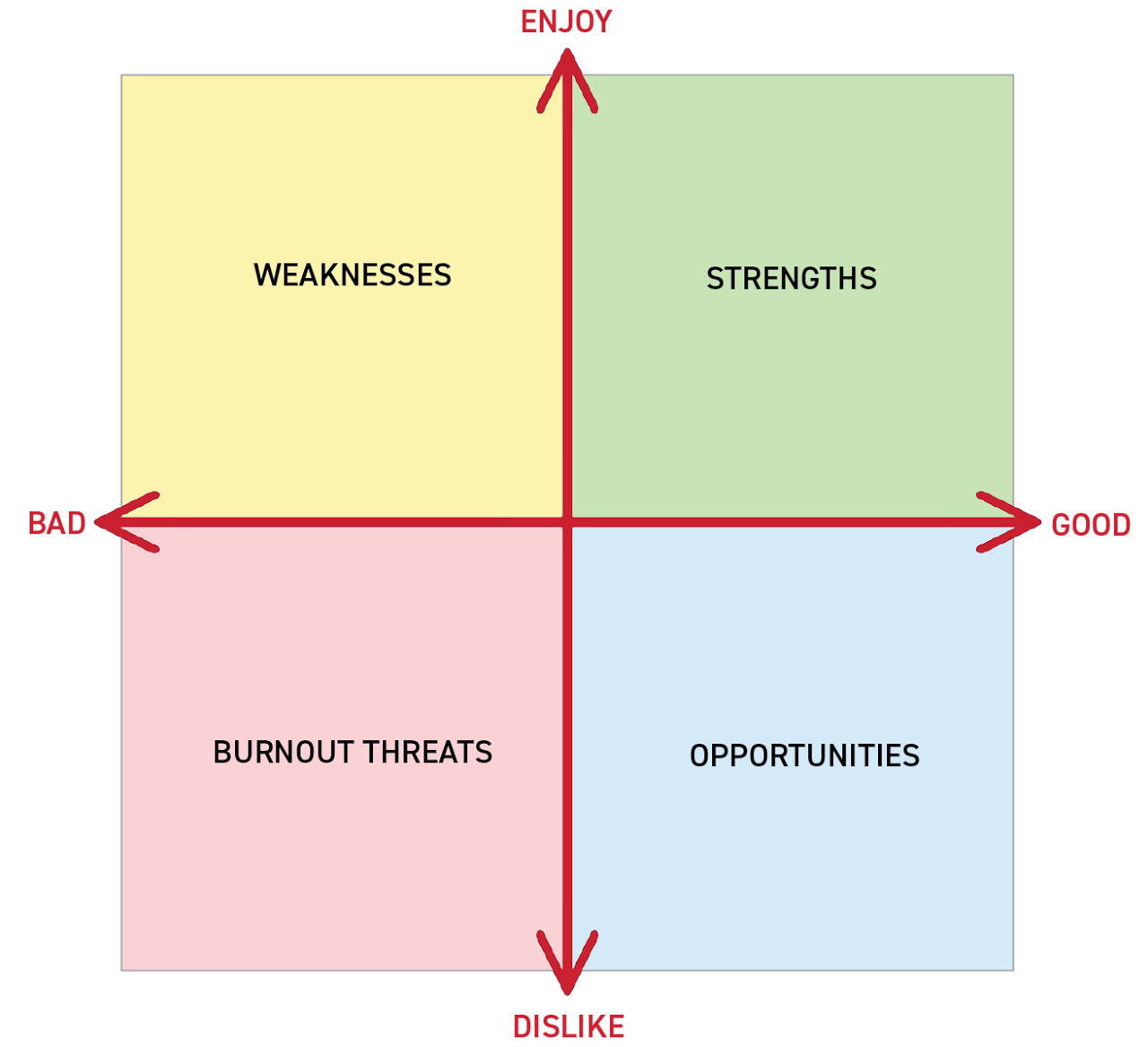
Getting to know your skill set is an important part of any job search. Before you can build an effective resume, you need to take stock of your skills and attributes! A great way to accomplish this is by filling out a skills matrix (or SWOT analysis). Categorize relevant skills (technical and power skills) into four categories:
Strengths: Skills you're good at and enjoy
Weaknesses: Skills you enjoy but struggle with
Opportunities: Skills you dislike but are good at
Threats: Skills you dislike and are bad at
This exercise encourages you to take stock of how prepared you are to embark on your career journey and gives you direction on which pathways you're best suited for.
How you choose to share your employment history should reflect not just what you've done, but what you want to do. Emphasize your most relevant experience and skills, and consider breaking your experiences up into work and industry experience sections.
Best Practices
List experiences in reverse chronological order. You want the focus to be on how much you've grown, not where you started.
Include title, company name, city & state, time range, and descriptions for each entry.
Include any results-oriented details or statistics that you can. Employers love to know what kind of outcomes you're capable of producing!
Always be specific about your contributions. Don't just list your job title, but explain your role and the value you brought to each position.
Industry and Work Experience
Consider splitting your employment history between work and industry experience.
Let's say you completed an internship last fall in graphic design, but since then you've worked a job in retail. Since your experience section is listed in reverse chronological order, that less relevant experience would end up listed on top. This is less than ideal for your career narrative.
To avoid this problem and to focus the attention of potential employers, you may want to break up your experiences. This way, you can avoid resume gaps and use non-industry positions to support important power skills, while also maintaining a focus on the most relevant roles you've worked in.
Action Words
You only have so much space on your resume, and you want your language to stay concise and direct. Because of this, word choice is everything in your resume.
Your goal is for each word to be as impactful as possible, particularly when it comes to the verbs you use. Take a look at this list of impactful action words that you can use in your experience descriptions. Using language with more meaningful, pointed connotations can increase your chances of being noticed and remembered by hiring managers!
Where can you tweak the wording on your resume to give a stronger impression?
You always have the option of including additional sections in your resume. You may want to add a section for Activities & Involvement, Relevant Coursework, Projects, or Awards & Publications. Just remember to stay focused on your career goals.
Why Include Additional Sections on Your Resume?
One important goal of your resume is to illustrate each skill you've listed (and most importantly, skills mentioned in the job description) in your experience descriptions. Anyone can list a skill on a resume; it's another thing entirely to be able to prove you possess a skill.
However, you may not have had the chance to use all of your skills in a professional setting. In this case, you'll want to add examples of how you've used and developed your skills through other opportunities. This may include volunteer, personal, extracurricular, or academic experiences. Regardless of how or where you've developed your skillset, it's important to share that context with potential employers.
Coursework On Resumes
As a student, it's acceptable (and even helpful) to include relevant coursework or school projects on your resume. Remember, your education is experience!
Keep in mind, you don't just want to list a class project and be done with it. Instead, add a little context. If it was a group project, how did you contribute? What programs or techniques did you use? And how have you gone above and beyond what was required for the class?
Employers love to see that you weren't just required to complete this project for a grade, but that you invested your time and energy into it beyond what was expected of you. This shows not just expertise, but a genuine passion for creating.
MORE RESUME TIPS
| DESIGN & LENGTH | WHAT TO AVOID |
|---|---|
|
|
UNDERSTANDING APPLICANT TRACKING SYSTEMS (ATS)
Because of how common ATSs have become, it's important to learn how to create an ATS-friendly resume.
Applicant tracking systems are software tools used by hiring teams to track and filter applications. With rising numbers of applicants, ATSs provide a way for hiring managers to quickly sort through applications by filtering for required skills, education, experience, and more.
Each time you submit your resume, there's a good chance it's fed through an ATS before it's seen by an actual human being. This means you have to beat the ATS before a hiring manager even gets the chance to consider your application.
If you're not intentional about creating an ATS-friendly resume, you might lose out on jobs that you're qualified for. These programs should inform the content, design, and formatting of your resume. Excessive designs, graphics, tables, columns, and even unusual fonts or headings can prevent a resume from being read by an ATS.
| DOs | DON'Ts |
|---|---|
| Keep your design as simple as possible | Don’t include excessive designs, pictures, or backgrounds |
| Use the most common fonts, headers, and resume structures | Don’t format using tables or columns |
| Take wording and key terms directly from job descriptions | Don’t use an incompatible file format (always check submission instructions) |
Pro Tip
Make two resumes.
If you have a designed copy of your resume that you're proud of or that exemplifies your creative ability, don't throw it out just yet!
Consider having a designed copy of your resume for use in interviews, career fairs, or networking settings.
Keyword Optimization
Most often, ATSs use keywords to identify the most qualified candidates. These keywords may include skills, experiences, or education requirements that the hiring team deemed most important.
The good news? You don't have to guess what these keywords are. They're in the job description. Make sure you tailor your resume to match the language of the job posting. This is not a situation where you want to put things in your own words. Use the exact wording of the required skills and job titles listed in the description. This way, your resume will rank higher in the filtered results, and you will be more likely to be noticed by an employer.
Copy and paste:
Copy and paste the text from your PDF resume into a Word document. How did it transfer? Is it readable? Did the order get confused? Note any issues and re-format as necessary.
Upload to an autofill application:
Go to any job board and scroll until you find an application that auto-fills when you upload your resume. Take note of which sections transfer and which don't. If the application can't autofill a piece of information from your resume, there's a good chance an ATS won't be able to read it either.
Use an online ATS optimization tool:
Use an online tool like Jobscan or Enhancv. These online tools allow you to upload your resume, and often a job description along with it, to measure not only how ATS-friendly your formatting and design are, but also how well you've optimized it for a specific job description.
UNDERSTANDING CAREER NARRATIVES
Your career narrative is the story of how you got to where you are and where you’re going next.
A career narrative is the practice of intentionally framing your professional history and skills to create a “story” that connects with employers. Stories are compelling! You don't want to be perceived as just a hodgepodge of facts and information. You want employers to see you as a full person with a unique history and value.
Creating a narrative in your application materials will help you stand out and connect with potential employers.
Consider Your Audience
It's not as simple an answer as you might think. Generally, you're crafting your materials for a hiring manager or hiring team, but it's important to get specific about your audience.
Who makes up the team you're trying to join? What are the organization's mission and values? What does the organization's industry tell you about what's important to them?
This might seem like a lot of work to do each time you write your resume, but it's worth it to increase your chances of forming a genuine connection with a potential employer.
Shape Your Narrative
Structure and ordering play a big role in developing your career narrative.
Keep experiences and education in reverse chronological order:
You want to emphasize how much you've grown, not where you started.
Prioritize industry experience:
By listing your industry experience over other work experience, you position yourself as someone who is focused on advancing in your chosen industry.
Emphasize relevant projects and coursework:
Are your aspirations better represented by projects, coursework, or other non-professional experiences? List those sections higher on your resume! Always lead with the most relevant details.
Focus Your Message
Every good story has a theme, something to anchor and focus the narrative. The same goes for your career narrative.
Your theme might be a passion, goal, or value that is central to your career journey. Keep in mind that it doesn't have to be complicated. It could be as simple as centering the field you're trying to break into.
For example, if you're trying to build a reputation as a character designer, you might craft your resume to emphasize how you've developed skills specific to that role or sought out projects or coursework that helped you toward that goal. Your cover letter would connect to that passion, and your portfolio would center on your best examples of character design.
This might sound obvious, but it's important to be intentional. Identify your theme and mold your career narrative around it.
Keep It Coherent
Your resume, cover letter, and portfolio work together to form your career narrative. Keep your messaging consistent without being repetitive.
Your materials should build off one another, each adding a new layer to your narrative. You have to consider the different elements of your application as pieces of a whole. This means keeping your design, content, and messaging consistent between your materials.
CCAD Career Services Guide
Cover Letters

WRITING A COVER LETTER
Despite their name, cover letters are rarely read before resumes. Instead of acting as a “cover” for your application, a tailored cover letter is the perfect opportunity to expand on and give more context to the information in your resume.
Unlike a resume, a cover letter cannot be reused for different applications. Research suggests that you are 53% more likely to receive an interview with a tailored cover letter, so you write one for each new position. Your cover letter is a chance to show off your research into the company and give specific examples of what makes you the best possible candidate for the job.

A student presenting their resume at the Connections Career Fair & Networking event.
ANATOMY OF A COVER LETTER
It's important to be formal and impactful when writing your cover letter.
At the top of your cover letter, include a heading with your name and contact information, including your city/state. It's best to use the exact heading from your resume. Listing your full address and the address of the recipient is no longer necessary.
Address your cover letter with "Dear [Hiring Manager Name]." You should be able to find a contact name in the job description or on the company website. If you’re unsure exactly who will be reading your cover letter, it’s okay to make a reasonable guess.
The first paragraph should lead with the position you’re applying for and why you’re interested. Aim to make a connection. This is the perfect opportunity to show off the research you’ve done into the organization, but make sure to keep it concise and direct.
The body of your cover letter should focus on the specifics of what you bring to the table in terms of skills and experience. Be careful not to simply repeat your resume. Identify and expand on only the most important details.
As you come to the end of your cover letter, it’s important to include a call to action. Let recruiters know how to contact you (phone, email, etc.) and that you’re prepared for the next steps. Be strong, but polite.
Always be respectful of the time employers take to read your materials. Be sure to thank them for their time and consideration, and sign off with a professional end salutation such as “sincerely” or “kind regards.”
MORE COVER LETTER TIPS
| DESIGN & LENGTH | PRO TIPS |
|---|---|
|
|
